Spark-ignition engines are the backbone of the modern automobile. They are smooth running, can accelerate quickly, and can be relied upon in passenger cars. The working of these petrol engines can best be explained by the four-stroke Otto cycle and accompanying thermodynamic diagrams. By observing the combustion process, piston movement and energy conversion in the cylinder, engineers may evaluate engine efficiency and optimize fuel economy. If you are a newbie, an engineering student or an automobile enthusiast, knowing the working of spark ignition engines will provide you with a good insight into the technology behind modern automotive.
READ MORE: Manual Transmission Explained: Diagram, Parts, Working & Types (Complete Guide)
What Are Spark-Ignition Engines?
The spark-ignition engine is an internal combustion engine in which the combustion of the fuel-air mixture is initiated by a spark from a spark plug located in the combustion chamber. They are often seen in gasoline-powered cars, motorbikes and small equipment.
The main operating mechanism of SI engine is based on the blend of fuel and air, compressing the mixture and igniting it with an electrical spark. The combustion produces energy in the form of pressure that pulls the piston down to provide mechanical power.
Key Features of Spark-Ignition Engines:
- Spark plug
- Piston Cylinder
- Connecting rod
- Crank Shaft
- Inlet and outlet valves.
How Spark-Ignition Engines Work
The working process of a spark-ignited engine starts on the intake stroke when the intake valve opens and a precisely adjusted fuel-air mixture enters the cylinder. As the piston goes down, the cylinder is filled with this combustible mixture and the engine is ready for the compression phase.
Then the piston goes up in the compression stroke and squashes the fuel-air mixture into a smaller space inside the cylinder. This increases the temperature and pressure ( by compressing the mixture ) resulting in more effective combustion and therefore better engine efficiency. The spark plug produces an electric spark at just the right moment to ignite the compressed mixture.
The combustion is highly rapid and produces high pressure gasses which expand powerfully in the cylinder. The expanding gases push down on the piston on the power stroke, delivering the mechanical force to operate the engine.
In this continuous cycle the engine turns the chemical energy contained in the fuel into meaningful mechanical effort. This is accomplished by thermal energy conversion. That is the basic basis on which modern petrol-driven internal combustion engines work.
Difference Between SI and CI Engines
Spark-ignition engines differ from compression-ignition (CI) engines, commonly known as diesel engines.
| Feature | SI Engine | CI Engine |
| Fuel | Petrol | Diesel |
| Ignition Method | Spark plug | Compression heat |
| Compression Ratio | Lower | Higher |
| Efficiency | Moderate | Higher |
| Noise Level | Smoother and quieter | Louder |
Because of their smoother operation and lighter design, spark-ignition engines are widely used in passenger cars.
Understanding the Four-Stroke Otto Cycle
The four-stroke Otto cycle is the ideal working procedure of a petrol engine. It is also called the petrol engine cycle as it is the operating sequence of most gasoline-powered engines.
This is the basic working principle of Otto cycle systems in four strokes.
1. Intake Stroke
During this stroke:
- Intake valve opens
- The piston goes down
- Air and fuel go into the cylinder.
When the piston moves down, it creates suction which sucks in the fuel – air mixture.
2. Compression Stroke
At this stage:
- Both valves are closed
- The piston moves up
- The mixture is squeezed
In the ideal Otto cycle, this process is called isentropic compression since it takes place without heat transfer. Increased compression improves combustion quality and promotes engine efficiency.
3. Power Stroke
The spark plug ignites the mixture at the end of compression at exact ignition timing.
The fast combustion process results in:
- High temp
- Gases under high pressure
- Downward piston pressure
This is the principal power-producing stage of the engine. Isentropic expansion of the expanding gases operates on the piston.
4. Exhaust Stroke
- The exhaust valve opens.
- The piston goes up
- Exhaust gases exit the cylinder
The cycle then repeats continually as the engine runs. The four-stroke gasoline engine delivers power smoothly and reliably.
Thermodynamic Processes in Otto Cycle
The Otto cycle is a theoretical thermodynamic cycle that describes the functioning of a gasoline engine.
The thermodynamic study of SI engine operation is concerned with the changes in pressure, temperature and volume during the cycle.
Assumptions of Ideal Otto Cycle:
The ideal cycle assumes:
- No heat loss
- Instant ignition
- Perfect gas behaviour
- Reversibility of Processes
Real engines are more complicated, but the model helps engineers assess performance.
Main Thermodynamic Processes
The four main thermodynamic steps of the Otto cycle are:
1. Compression, Isentropic
The piston compresses the fuel-air mixture with no heat transfer.
This raises:
- Pressure Temperature
- Energy density
2. Heating at Constant Volume
Combustion is quick with piston position being practically fixed.
This stage corresponds to the heat addition to the system.
The pressure increases rapidly as fuel burns.
3. Expansion Isentropic
Hot gases expand and force the piston down.
This turns thermal energy into mechanical work.
4. Heat Rejection at Steady State
At the end of the expansion the engine then dumps the unused heat before the following cycle.
This step is heat rejection.
These procedures describe how engines obtain engine efficiency via controlled energy conversion.
PV and TS Diagrams of Otto Cycle
PV diagram of Otto cycle and TS diagram of Otto cycle are important thermodynamic diagrams. These diagrams are used to explain the behavior and performance of petrol engines. The Diagrams show how pressure, temperature, entropy and volume change during different parts of the engine’s functioning. Engineers and students use these thermodynamic diagrams to examine the working mechanisms within an internal combustion engine and to have a better understanding of energy conversion during the combustion cycle.
The pressure-volume diagram of Otto cycle shows the pressure-volume connection in the Otto cycle.
P-V Diagram: y=f(V )

Fundamental Processes in PV Diagram
Compression Line (1-2)
- Volume reductions
- Pressure quickly rises
- Isentropic Compression (shown
Phase of heat addition (2–3)
- Combustion takes place
- Pressure grows sharply
- Volume remains almost unchanged
Expansion Phase (3-4)
- High pressure gases expand.
- Volume up
- Pressure falls slowly
Process of Heat Rejection (4-1)
- Exhaust heat exits the system
- Constant volume pressure decrease
The region contained by the PV curve is the useful work of the engine.
The link between temperature and entropy is shown by TS diagram of Otto cycle.
T-S diagram : y=f(S)

This diagram helps to understand:
- Entropy change Heat transfer
- Burning properties
- Loss of energies
The Importance of Thermodynamic Diagrams
These diagrams help the engineers to:
- Assess engine performance
- Compare engine designs
- Increase fuel economy
- Cut emissions
- Analysis of combustion quality
These are the greatest visual tools to get you started if you want to describe the Otto cycle with PV and TS diagram.
Efficiency of Spark-Ignition Engines
The performance of spark-ignition engines is commonly evaluated using Otto cycle efficiency.
Engine efficiency in petrol-powered systems depends on several important factors, including compression ratio, combustion quality, heat losses, mechanical friction, and fuel characteristics. In modern spark-ignition engines, improving these parameters helps achieve better fuel economy, smoother combustion, and enhanced thermal energy conversion.
Among all these factors, the compression ratio in the Otto cycle is one of the most critical parameters affecting performance and efficiency. It is defined as the ratio between the maximum cylinder volume and the minimum cylinder volume during the compression process.

A higher compression ratio generally improves engine efficiency because the compressed fuel-air mixture releases more usable energy during combustion. This leads to better thermal efficiency and more effective power generation during the expansion stroke.
The ideal Otto cycle efficiency can be expressed using the following thermodynamic equation:
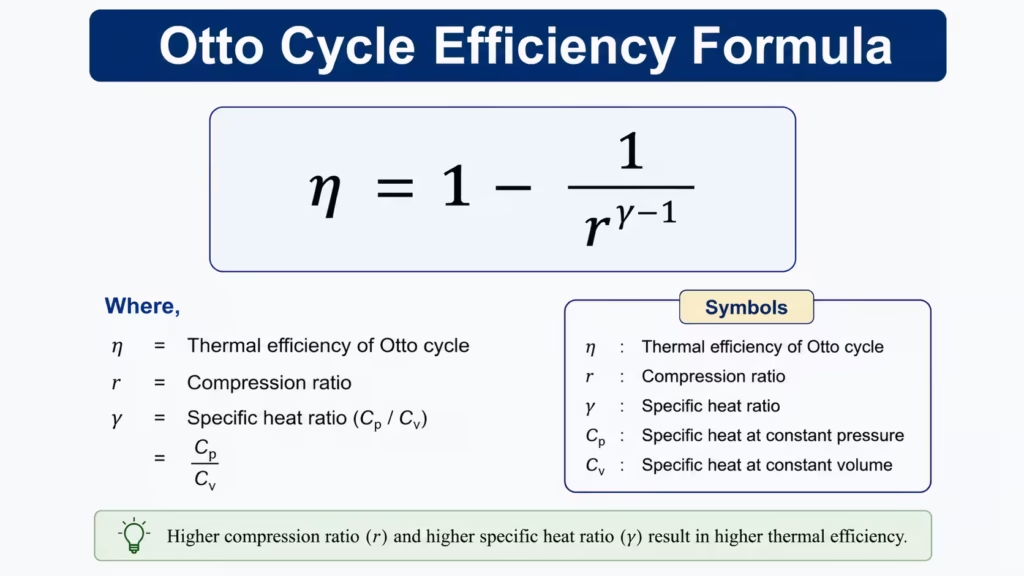
Where:
- η = thermal efficiency
- r = compression ratio
- γ = specific heat ratio of the working gas
This equation helps explain the thermal efficiency of the Otto cycle in thermodynamics and shows why increasing the compression ratio improves overall engine performance.
The Otto cycle is widely used in petrol engines because spark ignition allows precise control over the combustion process. Petrol vapor mixes easily with air, enabling smoother combustion and better drivability under varying operating conditions. In addition, the Otto cycle supports higher engine speeds, making it suitable for passenger cars and performance-oriented vehicles. However, excessively high compression ratios can lead to engine knocking, which limits further efficiency improvements and requires careful ignition timing control.
Advantages and Limitations of Spark-Ignition Engines
Advantages
One of the main advantages of spark-ignition engines is their smooth and quiet operation. They have lower vibration levels than many other types of internal combustion engine. They are light weight and compact in size making them very ideal for passenger vehicle, motorbikes and other automotive applications. These engines also give quick acceleration as petrol engines are more responsive to throttle input which makes for a more responsive drive. Also, spark-ignition engines are well adapted for everyday driving circumstances, offering smoother city driving, easier cold starts and increased driving comfort.
Limitations
But the benefits of SI engines are rather restricted. They are often less thermally efficient than diesel engines because more heat energy is lost in the combustion process. They are also more prone to knocking issues where improper ignition timing or high compression can lead to aberrant combustion within the cylinder. Petrol engines can also burn more fuel under heavy load conditions or in aggressive driving situations. However, despite these shortcomings, modern engine technologies continue to make advances in fuel economy, combustion efficiency and emissions performance.
Applications of Spark-Ignition Engines
Spark-ignition engines are used in many transportation and industrial applications:
- Most gasoline-powered vehicles use SI engines because of their smooth operation.
- Motorcycles benefit from lightweight petrol engine designs.
- Portable generators often use compact spark-ignition engines.
- Many hybrid cars combine electric systems with petrol engines for better efficiency.
- Sports cars use advanced SI engines for high-speed performance and rapid acceleration.
The versatility of spark-ignition engines makes them one of the most widely used power systems in the automotive world.
Conclusion
Understanding the SI engine working principle helps explain how modern petrol vehicles convert fuel into mechanical power. The four-stroke Otto cycle demonstrates the sequence of intake, compression, combustion, and exhaust processes that drive engine operation. Meanwhile, thermodynamic diagrams such as PV and TS plots provide valuable insight into pressure, temperature, and energy changes during the cycle.
The study of Otto cycle efficiency remains essential for improving fuel economy, reducing emissions, and enhancing overall engine performance. As automotive technology continues evolving, future spark-ignition engines will become cleaner, smarter, and more fuel-efficient through advanced combustion control and innovative thermal management systems.