Chain Drive Explained: Cycling along a quiet road at dawn or watching packages move along a factory line can be effortless and automatic. But lurking under the surface is a simple yet powerful system that really does the work of a chain drive.
At first sight, it appears as a simple chain travelling over a series of wheels. But despite its apparent simplicity, this mechanism is a crucial component that enables machines to function effectively.
What Exactly is a Chain Drive?
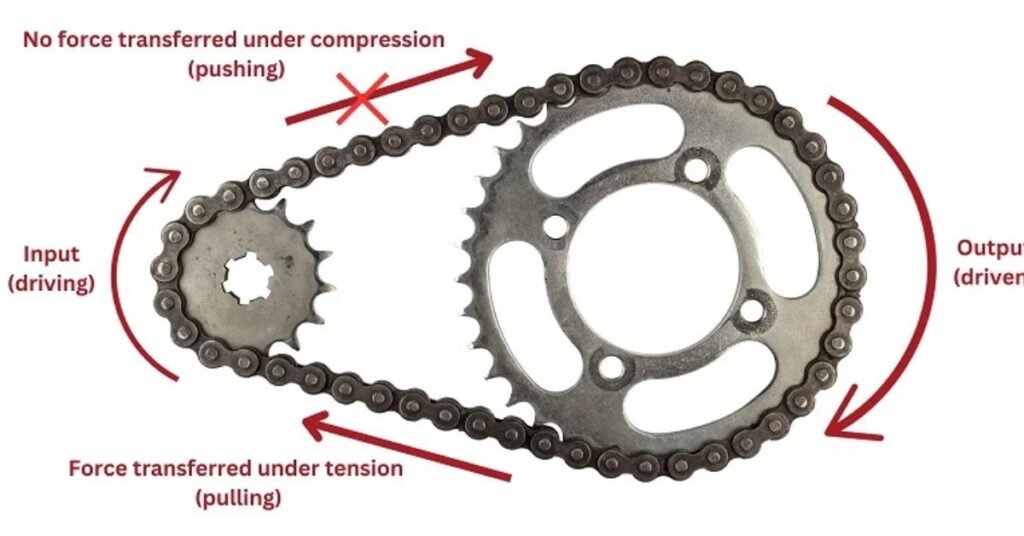
A chain drive is a means of transmitting power by way of a chain and two or more sprockets (wheels) attached to opposite ends of an assembly. As one sprocket rotates, it pulls the chain along with it. The result is a rotational force that is then received by the second sprocket and causes it to rotate.
One of the notable features of this machine is its use of chains and sprockets rather than a typical belt and pulleys. This method of movement has a firmer grip and cannot slip as a belt is known to do, especially under strain. It therefore provides more accurate and reliable results over time.
Our chain consists of metal links held together by metal pins within the links. Its flexibility is one of its strong points because it can be manipulated in many different configurations without sustaining damage under heavy loads.
A Few Terms That Help You Understand Better
For those who are new to the subject, a couple of terms should be explained. The chain pitch is the distance between the inner faces of two adjacent bare links. The pitch circle diameter is the diameter of the imaginary circle on which the chain would lie if it were wrapped around the sprocket. The sprocket is the toothed wheel that holds and guides the chain.
Types of Chain Drive
Chain drives are not generic items and are designed for various purposes depending on the intended application.
Hoisting and Hauling Chains
Our heavy-duty hoists are normally used in cranes, elevators and other lift equipment where high lifting capacity is required rather than high speed.
Oval link chains are commonly found in marine applications, such as anchors. Square link chains, on the other hand, are typically utilised in crane markets and, whilst a more affordable option, require proper handling as they can bend beyond elastic limits if excessively overloaded.
Conveyor Chains
A conveyor chain is a chain of repeating parts that are designed to move material from one point to another. Conveyor chains are found in almost every part of the manufacturing and distribution industry.
Our friction-reducing chains made of pins and rollers are designed to handle heavy loads. Some chains are interchangeable to form short lengths, and others are forged into one piece for long-lasting, industrial applications.
Power Transmitting Chains
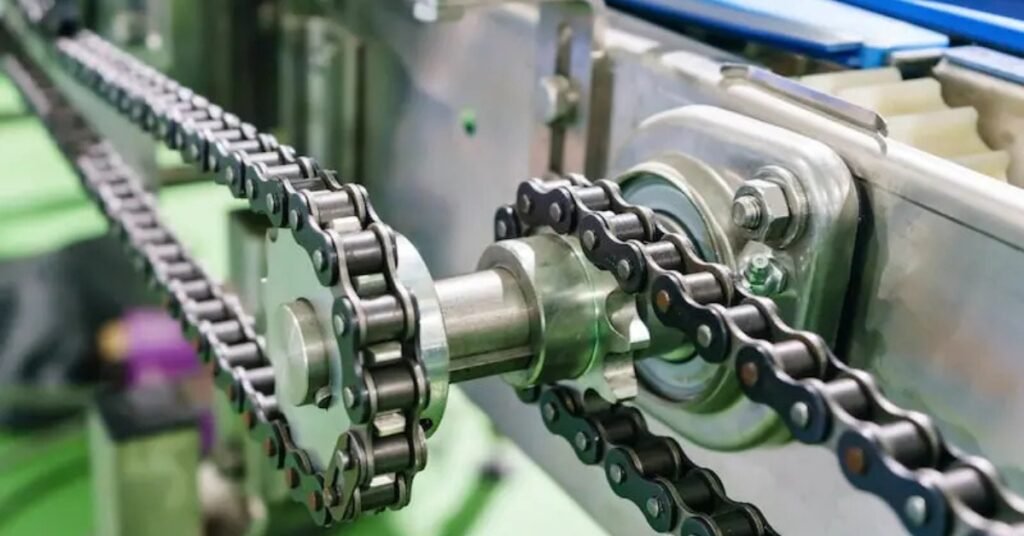
This is the most common type of chain and the one that most people are familiar with. If you have seen a bicycle or motorcycle chain in action, then you already know what this chain can do.
Some of these blockchain designs are older and are not in as much use today; the most common design is the roller chain block, which is strong and easy to maintain. The silent chain and hi-smooth chain were developed to provide extra smoothness and to be quieter than conventional chains.
Why Chain Drives Are Still So Popular
Chain drives have been in use for a very long time. Their longevity is for a reason.
- They offer high efficiency without slipping
- They work well in dusty, hot and humid environments.
- They don’t need frequent tweaking.
- They are suitable for light and heavy use.
They do the job well, without causing hassle.
Where They Fall Short
Of course, no single solution can be optimum in all respects. The chain drive has its disadvantages, too.
Seal rollers need to be lubricated on a regular basis, and incorrect alignment of the setup will likewise cause seal rollers to deteriorate more quickly. Seal rollers may become noisy as speed increases, and generally are not suited to applications where highly precise or silent movement is required.
Where You’ll See Chain Drives in Real Life
You might not even realise it, but there are chain drives everywhere: bicycles, motorcycles, transmissions. But on the big industrial machines, torque chains move massive parts with far more power and weight than any road bike.
Chain transmission systems or chain drives are used in conveyor systems, agricultural machinery, construction machines and elevators/hoists. In any machine, power generally needs to be transmitted to various parts of the machine. Chain drives are a common solution to this problem.
Why They Still Matter Today
Despite advances in technology, the chain drive is still widely used today. It is a simple construction, yet this very simplicity has made it a true workhorse in manufacturing.
They may not be the quietest or the most sophisticated type of lift installation, but as full-featured lift services, they deliver strength, reliability and efficiency.
Frequently Asked Questions (FAQs)
Why are chain drives preferred over belt drives?
This series of pencils does not slip or vary in speed when being used, making them very suitable for fine, precise work.
Are chain drives only used in vehicles?
Are hydraulic cylinders only used for impressively heavy jobs? No, they are widely used in industries where a simple conveyor system or a piece of machinery includes a cylinder.
Do they require regular maintenance?
Pivot points require proper lubrication as well as accurate alignment to maintain optimal performance.
What is a silent chain?
This chain is used for noise reduction & smooth operation.
Can chain drives handle long distances?
These tools are generally used for short to medium-length work, up to about 8 meters.
Also Read:
What Is a Countersunk Screw? Meaning, Uses, Types and Installation Guide
Types of Cars Explained: Complete Guide to Car Body Styles and Vehicle Types
Volkswagen Group Brands List 2026: All Companies Owned by VW Explained