It is apparent from the Volkswagen Group brands list that there is a hierarchical organization in the automotive industry, whereby several automobile brands coexist under the same organizational structure.
The Volkswagen Group brands list comprises different luxury automobile brands, affordable automobile brands, and trucks, each placed in its own brand hierarchy. The VW Group brands play an integral role in a wider network of international automobile firms and subsidiaries.
It seems that the organization aligns with trends that are common among big car manufacturers.
Who Owns Volkswagen?
The ownership in the Volkswagen group continues to be spread out among strategic and institutional shareholders. The Porsche SE controls the voting share while the State of Lower Saxony owns an influential minority stake. Other investors are able to invest via publicly-traded stock, just like any other big car company does.
What is Included in Volkswagen Group Portfolio
The VW Group brands list showcase a wide-ranging group of offerings that extend from passenger cars to commercial vehicles and further to other areas of mobility services. There is an element of segmentation to the organization, in which different components perform distinct functions. This organizational design continues to be in line with what can be seen in big automotive companies.
- Passenger car segments
- Luxury/performance oriented brands
- Budget volume models
- Commercial vehicles (trucks and buses)
- Financial/mobility service operations
- Motorcycle manufacturing segment
How Many Brands Are Under Volkswagen Group
However, the VW Group brands list include several numbers of important core brands in the automobile segment or related to mobility services in total number around twelve. This number stays consistent despite any changes in the categorization within the automobile industry structure.
| Category | Number of Brands |
| Passenger Car Brands | 7–8 |
| Luxury & Performance | 3–4 |
| Commercial Vehicles | 2–3 |
| Motorcycle Brands | 1 |
| Total (Approx.) | 12 |
List of Brands Owned by Volkswagen Group
The brands portfolio of the Volkswagen Group consists of a combination of volume producers, luxury producers, and niche brands that function as part of an integrated corporate structure. The brands seem to be classified at varying layers of the market.
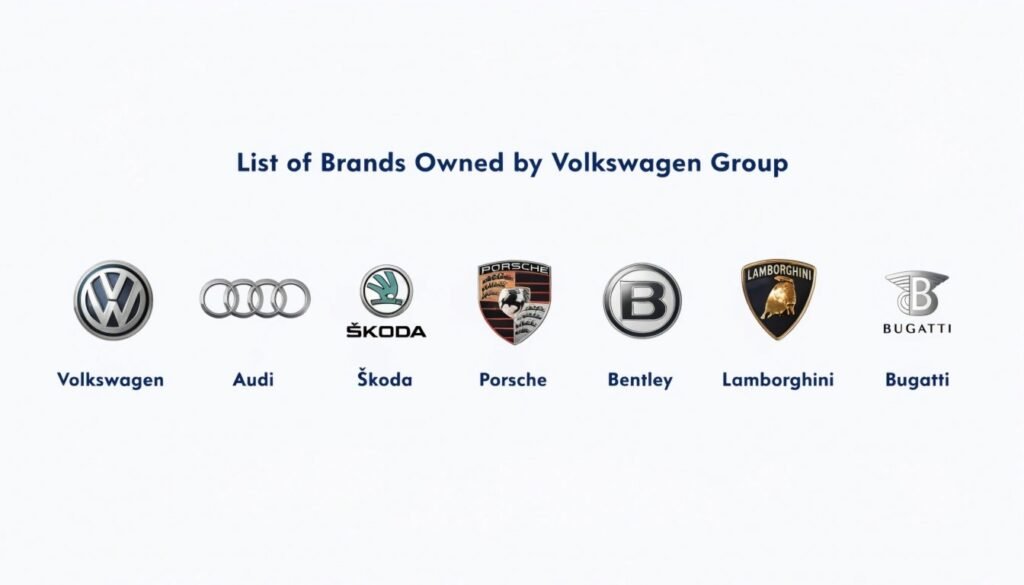
- Volkswagen
- Audi
- Škoda
- SEAT / Cupra
- Porsche
- Bentley
- Lamborghini
- Bugatti (historical association)
- Ducati
- Volkswagen Commercial Vehicles
- Scania
- MAN
Companies Owned by Volkswagen Group Worldwide
The list of VW Group brands list does not only cover their core brands but also encompasses a cluster of firms engaged in manufacturing, logistics, and finance. These businesses exist in a decentralized structure, wherein their regional and functional responsibilities are well-defined.
Passenger Vehicle Companies
- Volkswagen Passenger Cars
- Audi Group entities
- Škoda Auto operations
- SEAT and Cupra divisions
Luxury and Performance Companies
- Porsche AG
- Bentley Motors
- Lamborghini operations
Commercial and Transport Companies
- Volkswagen Commercial Vehicles
- Scania AB
- MAN Truck & Bus
Other and Supporting Companies
- Ducati Motor Holding
- Financial services and leasing units
- Mobility and software-related subsidiaries
Volkswagen Group Brands and Brand Groups Explained
The brands under the Volkswagen Group clearly show a clear clustering pattern, where each brand functions within specific clusters that are categorized according to its positioning and functionality. The brand clusters seem to belong to either the volume, premium, or performance categories, enabling them to run parallel to one another in the industrial and economic context of automobiles.
Volkswagen Group Brand Hierarchy and Structure
There exists a hierarchical structure in which brands in the VolkswageVW n Group brands list are categorized in accordance with their pricing position, technological perspective, and functionality in the market. The structure is apparently stable with each tier functioning in different segments but with the same platform beneath.
Core / Volume Brands
- Volkswagen
- Škoda
- SEAT / Cupra
Premium Brands
- Audi
Sport and Luxury Brands
- Porsche
- Bentley
- Lamborghini
Commercial and Specialized Brands
- Volkswagen Commercial Vehicles
- Scania
- MAN
Motorcycle Segment
- Ducati
Volkswagen Group Premium vs Budget Brands
The VW Group brands list shows a clear separation between premium and budget segments, where pricing, design approach, and production scale vary across categories. This distinction appears consistent with industry patterns where multi-brand groups distribute offerings across income levels and regional demand structures.
| Segment | Brand Examples | Positioning Characteristics |
| Budget / Volume | Volkswagen, Škoda, SEAT | High production scale, broad markets |
| Mid-Premium | Audi | Technical focus, brand differentiation |
| Luxury / Performance | Porsche, Bentley, Lamborghini | Low volume, high price positioning |
Volkswagen Group Passenger Car Brands List
The VW Group brands list includes several passenger car manufacturers operating across volume and premium segments. These brands appear integrated within shared production and platform systems while maintaining distinct identities in global markets.
- Volkswagen
- Audi
- Škoda
- SEAT
- Cupra
- Porsche
Volkswagen Group Luxury Car Brands List
The Volkswagen Group brands list also contains a set of luxury and performance-oriented manufacturers that operate with lower production volumes and higher pricing structures. These brands reflect a specialized segment within the group’s broader portfolio.
- Porsche
- Bentley
- Lamborghini
Volkswagen Group Motorcycle and Commercial Brands
The VW Group brands list extends beyond passenger vehicles into motorcycle and commercial segments, where operational structures differ from standard car manufacturing. These divisions appear aligned with transport, logistics, and niche mobility functions.
- Ducati (motorcycle segment)
- Volkswagen Commercial Vehicles
- Scania
- MAN
Volkswagen Group Subsidiaries List with Ownership Details
The Volkswagen Group brands list extends into a network of subsidiaries where ownership levels vary between full control and majority stakes. This structure appears typical of large automotive groups, where operational entities remain aligned under central governance while retaining brand-level independence across global markets.
Core Automotive Subsidiaries (Majority-Owned)
- Audi AG (majority ownership)
- Škoda Auto (wholly owned)
- SEAT S.A. / Cupra (wholly owned)
- Volkswagen Passenger Cars (core division)
Luxury and Performance Subsidiaries
- Porsche AG (majority ownership via group control)
- Bentley Motors (wholly owned)
- Lamborghini (wholly owned through Audi division)
Commercial Vehicle and Transport Subsidiaries
- Volkswagen Commercial Vehicles (internal division)
- Scania AB (majority ownership)
- MAN Truck & Bus (majority ownership)
Other Strategic Subsidiaries
- Ducati Motor Holding (owned via Audi)
- Financial services entities (leasing and credit operations)
- Software and mobility units within group structure
Volkswagen vs Audi vs Porsche Ownership Comparison
The VW Group brands list shows layered ownership relationships where Audi and Porsche operate as controlled entities within the group, while Volkswagen functions as the central brand. These relationships reflect a holding structure in which strategic control remains consolidated at the group level.
| Entity | Ownership Position | Control Structure |
| Volkswagen | Core brand within parent group | Operates under Volkswagen Group |
| Audi | Majority-owned subsidiary | Fully controlled by Volkswagen Group |
| Porsche | Public company with group control | Majority controlled by Volkswagen Group |
Who Owns Porsche, Audi and Lamborghini
Within the Volkswagen Group brands list, Audi and Lamborghini remain fully controlled subsidiaries, with Lamborghini operating under Audi. Porsche appears as a publicly listed entity where controlling interest remains with Volkswagen Group, reflecting a layered ownership model common in large automotive organizations.
Volkswagen Truck and Bus Companies Under TRATON
The VW Group brands list includes a dedicated commercial vehicle structure managed through TRATON Group. This division brings together major truck and bus manufacturers under a unified framework. The arrangement appears aligned with industry patterns where heavy vehicle operations remain separated from passenger car systems while sharing financial and strategic oversight.
| Company | Segment | Ownership Position |
| Scania | Heavy trucks & buses | Majority-owned under TRATON |
| MAN Truck & Bus | Trucks & transport | Majority-owned under TRATON |
| Navistar International | Commercial trucks | Controlled via TRATON |
Volkswagen Group Heavy Vehicle Division Explained
The Volkswagen Group brands list reflects a distinct heavy vehicle division operating separately from passenger car activities. This structure appears centered on industrial transport requirements, where production, logistics, and distribution systems follow different cycles. The division remains aligned with freight movement, regional regulations, and long-haul transport demand across global markets.
Volkswagen Group Logistics and Transport Brands
The Volkswagen Group brands list includes several entities linked to logistics and transport functions, where operations extend beyond vehicle manufacturing into movement and fleet systems. These brands appear integrated within commercial and industrial transport networks.
- Scania
- MAN Truck & Bus
- Volkswagen Commercial Vehicles
- Navistar International
History of Volkswagen Group Acquisitions Timeline
The VW Group brands list reflects a gradual expansion shaped by acquisitions that appear aligned with segment coverage and geographic reach. Early developments centered on consolidating domestic operations, followed by the inclusion of European manufacturers such as Audi and Škoda Auto. These additions indicate a shift toward multi-brand structuring within the automotive industry.
Later phases show movement into premium and performance segments through acquisitions like Bentley Motors, Lamborghini, and Porsche. The timeline also includes expansion into commercial vehicles with Scania and MAN Truck & Bus, reflecting diversification across transport segments.
Evolution of Volkswagen Group Brand Portfolio
The Volkswagen Group brands list shows a progression from a single-brand manufacturer toward a multi-layered portfolio. Early structure remained centered on volume production, while later integration of regional and premium brands introduced variation in pricing, engineering focus, and market positioning. The portfolio appears to have expanded in parallel with global demand shifts.
Over time, the portfolio structure reflects clearer segmentation between volume, premium, and luxury brands. This arrangement remains consistent with patterns observed among global car manufacturers, where platform sharing coexists with distinct brand identities. The inclusion of motorcycle and heavy vehicle divisions indicates a broader interpretation of mobility within the group’s operating framework.
Key Milestones in Volkswagen Group History
The VW Group brands list reflects a series of milestones that mark transitions in ownership structure, market expansion, and portfolio development. These points appear linked to broader changes in the automotive industry and global manufacturing systems.
- Formation of Volkswagen as a state-supported manufacturer in the 20th century
- Integration of Audi into the group structure
- Acquisition of Škoda Auto following market liberalization in Central Europe
- Expansion into luxury segment with Bentley Motors and Lamborghini
- Gradual control over Porsche through complex ownership alignment
- Establishment of commercial vehicle division including Scania and MAN Truck & Bus
- Development of multi-brand portfolio spanning passenger, luxury, and transport segments
Volkswagen Group Global Presence and Operations
The Volkswagen Group brands list is characterized by extensive geographical dispersion. The manufacturing and assembling processes are carried out in Europe, Asia, and America. Manufacturing processes are consistent with regional demand trends, whereas the logistics network works on both regional and international levels. Such organization facilitates the maintenance of extensive automotive systems.
The VW Group brands list is also applicable to sales and services networks that work under various governmental regulations. The market coverage looks diversified, as vehicles are distributed according to regional preferences, prices, and logistical infrastructure.
Why Volkswagen Owns So Many Car Brands
There is an evident trend on the Volkswagen Group brands list indicating the use of multiple brands in various market segments. This phenomenon seems to be associated with the inclusion of products in various price ranges, region-specific preferences, and different engineering techniques. Every brand operates within a certain scope but still belongs to an interconnected system.
Moreover, the VW Group brands list demonstrates that diversity within brands serves as an element helping to distribute risks and stabilize the market. Different brands cope with fluctuating cycles of demand, which helps the whole organization remain stable amid changes in the economy and the industry.
- Budget, premium, and luxury market segments covered
- Region-specific market demands addressed
- Distinctiveness of brands operating within a common platform
- Risk distribution among brands
Benefits of Multi-Brand Strategy in Automotive Industry
Example of brands from the Volkswagen group gives us an idea about how multi-branding takes place in the automobile industry. This type of strategy seems to facilitate parallel production processes whereby various brands run on their own yet have access to similar technologies and supply chains.
- Broader market reach across income segments
- Platform sharing across multiple auto brands
- Flexibility in production and supply systems
- Stability during demand variation across regions
- Distinct positioning among global car companies
How many brands are presently operating under Volkswagen Group?
The Volkswagen Group is home to more than a dozen brands in passenger cars, luxury cars, motorcycles, and commercial vehicles. The exact number does not change much, even though there can be some changes internally from time to time.
What types of vehicles are included in the Volkswagen Group portfolio?
The VW Group brands list includes passenger cars, performance vehicles, motorcycles, and heavy commercial vehicles. This range reflects a portfolio that spans everyday mobility, premium segments, and industrial transport applications across global markets.
Is there full ownership of all brands by Volkswagen?
Ownership is not uniform across all companies. There are those who continue to be completely owned, others running as majority owned firms, and still others operating through layers of shareholding systems.
Why are brands like Audi and Porsche kept separate?
The VW Group brands list shows that brand separation allows distinct identity, pricing, and engineering direction. This structure helps maintain differentiation across segments while shared platforms and systems continue operating beneath the surface.
How does Volkswagen manage both budget and luxury brands together?
The VW Group brands list reflects a segmented approach where budget and luxury brands operate independently within a shared framework. Each brand aligns with a specific market tier, while production systems and resources remain interconnected at the group level.
Are the truck and bus divisions of Volkswagen interconnected?
The heavy vehicle business continues to operate through its own commercial system. The truck and bus divisions have their own segments where they can follow different production processes as opposed to the car manufacturing process.
Conclusion
The Volkswagen Group brands list displays an organizational pattern in the automobile industry whereby there are several car brands that run in different categories and locations. The list of Volkswagen Group brands still follows trends in the global automobile industry whereby there is brand structure, car brands globally, and diverse operations to create a balanced automobile lineup.