Wankel Rotary Engine Explained: Engines are a component of our life. They drive almost everything that surrounds us; cars and bikes, aircraft and machines. Piston engines are known to most of the people so all the components move up and down to produce the power. But there is another interesting engine which functions in an entirely different manner and that is the Wankel rotary engine.
This engine is also characterized by smooth operation, small size and distinctive design. These are just some of the questions you will answer in this article, and they will be answered in a very understandable and easy to comprehend manner.
What is a Wankel Rotary Engine?
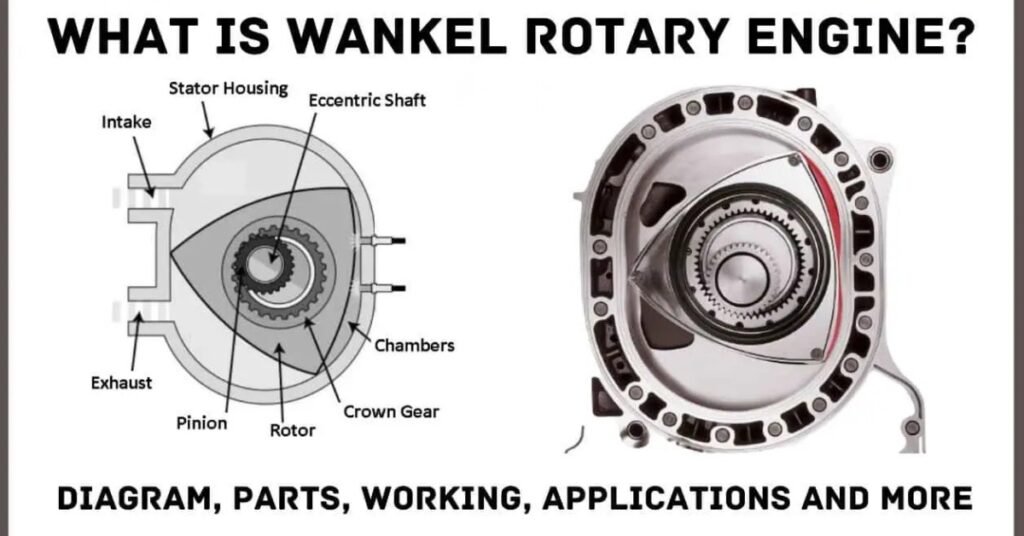
The wankel rotary engine is a form of internal combustion engine, where the triangular rotor being used is a rotor rather than the pistons that are used in the conventional internal combustion engines. It was developed by a German engineer by the name Felix Wankel.
Pistons in a normal engine move up and down into cylinders to generate power. However, in a Wankel engine, the rotor is rotating within a chamber of a special shape. This rotary motion is the direct conversion of pressure into rotary motion and this engine is smoother and less complicated.
The Wankel engine minimizes vibration, moving parts, and its design has a higher power-to-weight ratio than many other engines.
Main Parts of a Wankel Engine
Wankel engine is also mechanically simple as compared to the piston engines. Its main components include:
- Rotor -A triangular-shaped component which is rotating and like a piston.
- Housing -The external room or chamber over which the rotor rotates.
- Eccentric Shaft -Transforms rotors movement into useful rotational energy.
- Apex Seals -These are found on the edges of the rotor to cover the combustion chambers.
- Spark Plugs – Ignite mixture of fuel and air.
- Intake Port- This is the entry point of the air-fuel mixture.
- Exhaust Port- releases burnt gases.
- Combustion Chamber- This is where the fuel burns to produce energy.
These components are connected to form an uninterrupted and smooth power cycle.
How Does a Wankel Engine Work?
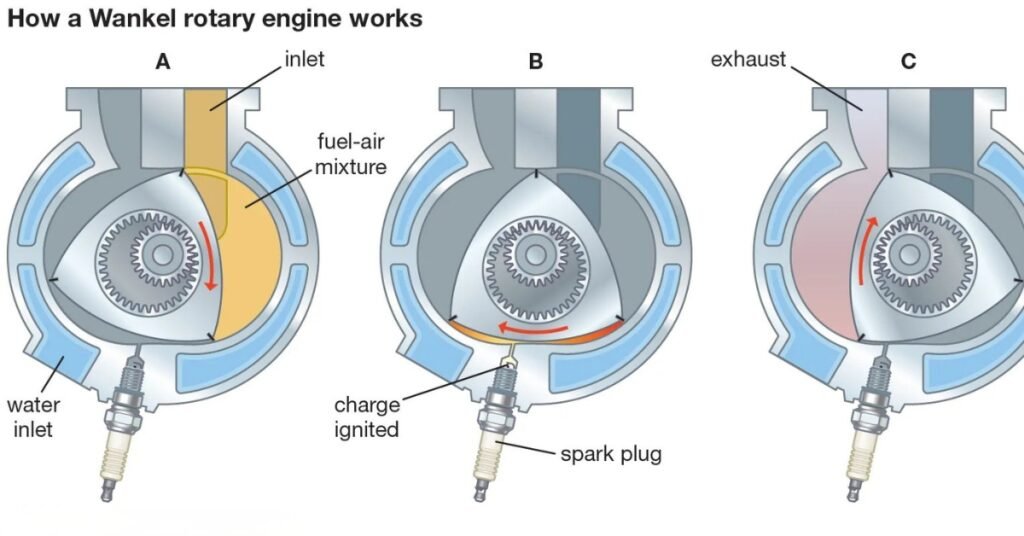
The Wankel engine has the same four essential steps as a standard engine however, the process takes place in a different way.
Intake
The rotor rotation results in the formation of a vacuum which pulls the air-fuel mixture inside the chamber via the intake port.
Compression
The rotor goes on rotating, sucking up the quantity of the mixture and decreasing the quantity of the chamber.
Combustion
The mixture is ignited by spark plugs. This forms expanding gases which act to push the rotor and produce power.
Exhaust
Rotor keeps moving and the burnt gases are forced out through the exhaust port. The first thing that is worth noting is that all these occur concurrently in various parts of the engine. This yields smoother and continuous power output as opposed to the piston engines.
What is so Uncommon About the Wankel Engine?
The Wankel engine is not popular nowadays even though it is an innovative engine. This is due to a number of reasons:
- It is not as fuel efficient as the modern piston engines.
- Apex seals are easily worn out leading to maintenance problems.
- It has a greater emission because of uncomplete combustion.
- It burns more oil when it is running.
All these complicate the issue of the Wankel engine to comply with the current environmental and efficiency regulations.
Advantages of Wankel Engine
Wankel engine continued to have many advantages that made it suitable in some applications:
- Small size and light weight, which allows it to fit in small areas.
- Less mechanism, which lessens the complexity of the mechanism.
- Smooth and near-vibration free action.
- Powerful performance, when compared to size.
Due to the merits, it has been greatly employed in performance cars.
Faults of Wankel Engine
Simultaneously, it also has significant abuses:
- More fuel burnt than piston engines.
- Lower torque at low speeds
- Maintenance has to be done frequently, particularly seals.
- There is increased emission, thus rendering it unsustainable.
These drawbacks have restricted its application in contemporary standard cars.
Applications of Wankel Engine.
Although the usage of the Wankel engine is less frequent today, the engine is still applied in certain spheres:
- Sport cars, in particular, the models designed by Mazda.
- Weight and smoothness are also important in light aircraft.
- Experimental/Limited production motorcycles.
- Electric vehicles have range extenders.
- Minor machinery like go-karts and personal watercraft.
Its low weight and power-to-weight ratio makes it fit well in these special purposes.
Wankel Reciprocating Engine vs Quick Comparison
- Characteristic Wankel Engine Piston Engine
- Motion Rotary Up and down
- Parts Fewer Many
- Size Compact Larger
- Vibration Very low Higher
- Efficiency Lower Higher
Frequently Asked Questions (FAQs)
Who is the inventor of the Wankel engine?
The rotary engine was invented by Felix Wankel.
What does it differ with a piston engine?
It employs a rotating rotor rather than up and down movements of pistons.
Why does not it have a common use nowadays?
Due to the fuel efficiency problems, emissions, and convenience problems.
What company is known to use the Wankel engines?
The most popular company that deals with this technology is Mazda.
Does the Wankel engine have power?
Yes, it is highly power to weight and hence highly efficient in its size.
Disclaimer: This paper is not intended to provide a solution. Depending on the design of the engine and the manufacturer, it can differ in technical specification and performance. Whether one requires extensive mechanical knowledge or is a professional always refer to qualified engineers or official sources.
Also Read:
Propeller Shaft vs Drive Shaft: Key Differences, Functions and Uses Explained
16 Types of Measuring Tools and Their Uses in Engineering and Construction
Propeller Shaft vs Drive Shaft: Key Differences, Functions and Uses Explained