Propeller Shaft vs Drive Shaft: Let’s be real for a moment. As you read words such as propeller shaft and drive shaft, you get an impression that they are one. And frankly, a great many people interchange them. But here, the fact is -they are connected, and yet not identical.
In case, you are the person who is trying to learn more about your car or troubleshoot an incorrect situation, this difference can help you save time, energy and even finances. Now then let us reduce it to the most basic form possible.
Propeller Shaft vs Drive Shaft
| Topic | Details |
|---|---|
| Propeller Shaft | Transfers power between transmission and rear differential |
| Drive Shaft | General term for any shaft delivering power to wheels |
| Main Difference | Prop shaft is specific type; drive shaft is a broader term |
| Common Use | Prop shaft in RWD & 4WD, drive shaft in all vehicles |
| Size | Prop shaft is usually longer, drive shaft can be smaller |
| Key Function | Transmit torque and rotation to move vehicle |
What is a Propeller Shaft?
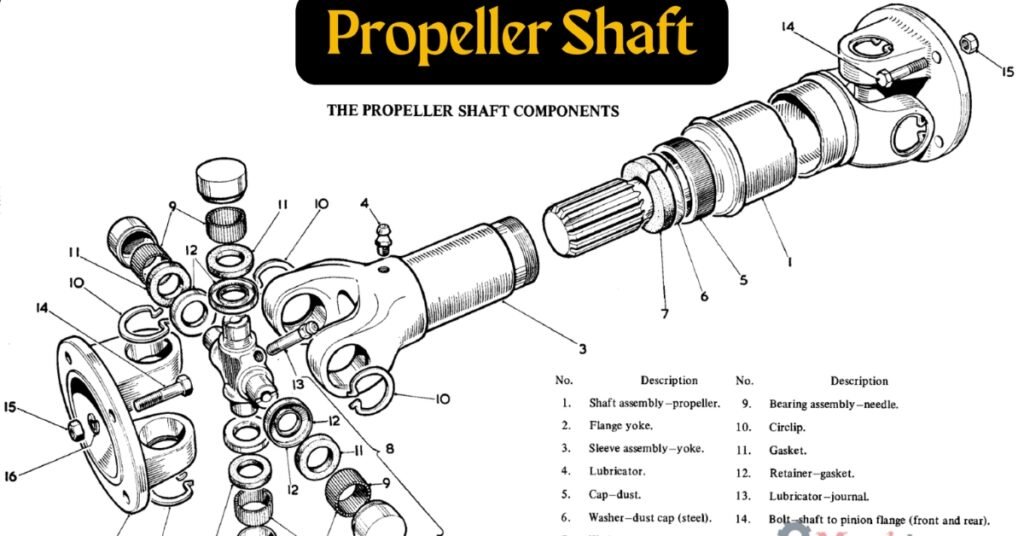
A propeller shaft also known as a prop shaft is a section that gives the transmission of power to the rear differential. It functions through conveyance of torque and rotational force.
Propeller shafts are mainly found in:
- Rear-wheel drive (RWD) automobiles.
- Four-wheel drive (4WD) vehicles
Its primary occupation is not complicated but significant. It links components that are not closely related or are distant and it has the ability to transfer power easily even when it is being driven over rough roads.
Due to the amount of stress it is exposed to, the propeller shaft has to be:
- Tough enough to deal with torsion.
- Lightweight in order to decrease additional weight.
- Bendable to move with.
What is a Drive Shaft?
A drive shaft is a more general classification. It is any shaft that directs power to the wheels that has been carried out by the transmission.
Put simply, all propeller shafts are drive shafts but not all drive shafts are propeller shafts.
Almost all vehicles include drive shafts which include:
- Front-wheel drive (FWD)
- Rear-wheel drive (RWD)
- All-wheel drive (AWD)
- Four-wheel drive (4WD)
They are primarily meant to transform engine power to motion and to assist the wheels to turn and propel the vehicle either forward or backward.
Significant Prop Shaft vs. Drive Shaft Difference
Although they both transfer power, there are certain differences that are apparent.
Scope
Prop shaft is a particular term whereas the drive shaft is a general term.
Usage
Prop shaft is predominantly common in RWD and 4WD vehicles.
In every kind of vehicle, drive shaft is employed.
Position
Prop shaft puts transmission to rear differential.
Can be design to join various parts with drive shaft.
Size
Prop shafts tend to be longer.
Short drive shafts may be used, particularly in FWD vehicles.
This difference can assist you in part identification during repair and diagnosis of problems.
Types of Drive Shafts
Various vehicles have different kinds of drive shafts depending on the design used.
Solid Drive Shaft
Applied primarily in the rear-wheel drive cars. It is an one-piece shaft joining transmission to the rear-axle.
Two-Piece Drive Shaft
Usually common in trucks and long vehicles. It divides into two parts to deal with more extended distances successfully.
Front Drive Shaft
Applied to four-wheel drive vehicles. It drives the power to the front wheels.
CV Axle Shaft
Located at the front wheel drive and AWD cars. It links up with the wheels and gives it a smooth motion when steering.
Parts of a Propeller Shaft
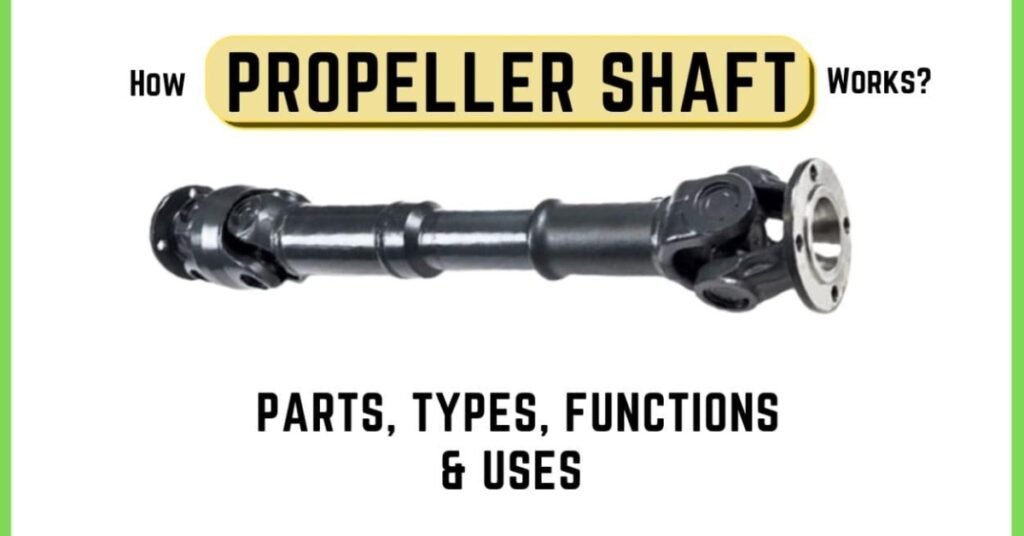
A propeller shaft consists of various components that make it very important in its performance.
U-Joint
Linking rotating shafts and permits rotation at angles.
Tube
Primary shaft of the shaft that carries the torque.
Center Bearing
Holds long shafts and eliminates vibration.
Midship Shaft
Helps attach a series of shafts together.
End Yoke
Reduces noise and vibration
Slip Yoke
Allows the adjustment of length in movement.
Flanges
Link the shaft to transmission and the differential.
The various parts contribute to balance and transfer of power smoothly.
Propeller Shaft functions.
The propeller shaft does not just spin. It is adjusted to the conditions of the real world.
When you are driving through bumps or unequality of the road:
- The rear axle is moved in an up and down motion.
- The angle of components varies.
- The shaft is able to change its length and position.
- This flexibility will insure that the flow of power will not be interrupted.
Propeller Shaft Materials
Propeller shafts are designed to withstand stress and rotation that require very hard materials including:
- Hardened steel
- Alloy steel
- Spring steel
These materials offer the ability to maintain the shaft in balance and efficiency.
Types of Propeller Shafts
Single Piece Shaft
Applied in cases where there is a low distance between the transmission and the axle. It is simple and strong.
Two or Three Piece Shaft
Used in larger vehicles. Division of the shaft increases performance and lessens vibration.
Critical Requirements of Effective Performance
A propeller shaft should be able to accomplish the following conditions to be functional:
- High torsional strength
- Tough and toughened material.
- Adequate positioning and integration.
- Balancing during rotational movement.
- Minimized thrust load to minimize vibration.
Failure to meet these conditions may result in the rapid wear of the shaft or result in performance problems.
FAQs
Is propeller shaft and drive shaft identical?
Not exactly. A propeller shaft is a drive shaft, though not necessarily the same.
What are the vehicles that consume propeller shafts?
Predominantly four-wheel drive and rear-wheel drive cars.
Is it possible that a drive shaft could be small?
Yes, particularly on front wheel drive cars.
What would occur in case a propeller shaft goes dead?
The car can lose power transmission and come to a halt.
Are these shafts in need of maintenance?
Yes, frequent inspection will help to eliminate vibration and failure.
Disclaimer: This paper is not informative. The systems of vehicles may differ with the manufacturer/model. You should never do any repair or replacement of any part of the vehicle without consulting a professional mechanic or going to the official manual of your vehicle.
Also Read:
20 Basic Car Interior Parts Name with Functions and Pictures
16 Types of Measuring Tools and Their Uses in Engineering and Construction
Service Theft Deterrent System Explained: Causes, Fixes, and Reset Guide