Piston in Engine Explained: We all have at one time or another asked ourselves the question, what, exactly, makes a car engine move, and most of the time the answer has to do with a single small but mighty part of the engine, the piston. It operates without any noise in the engine, has to cope with great heat and pressure, but it performs one of the most significant functions when you want to see your car running without any issues.
You will learn in this article what is a piston, its functioning, its parts, types, common failures, and the significance of a piston, all in a non-complicated and human friendly manner.
What is a Piston?
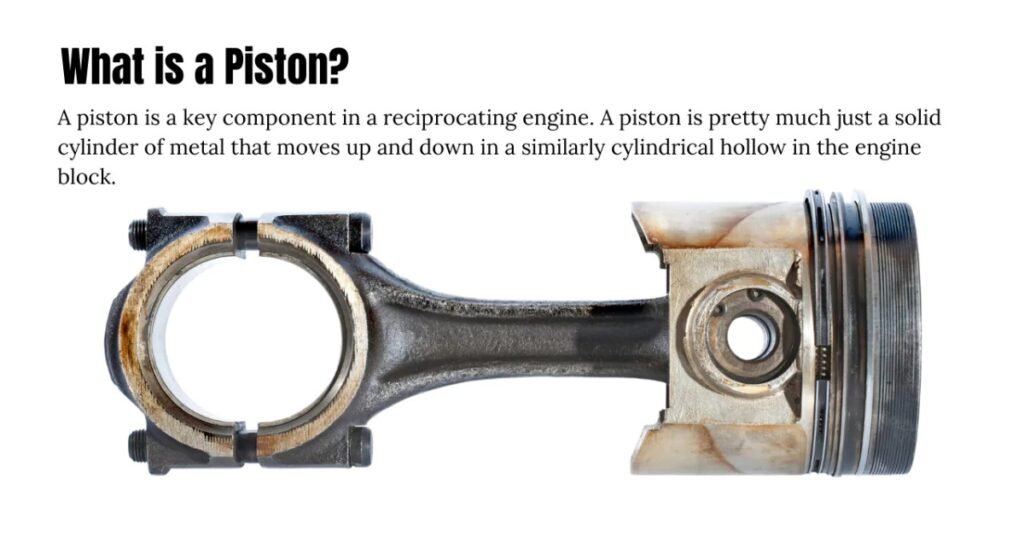
A piston is a metal cylindrical piece which is rising and falling inside the engine cylinder. It is the bottom section of combustion chamber and it is attached to the crankshaft by a connecting rod.
The piston simply transforms the energy generated by combustion of the fuel into a mechanical motion. This movement finally rotates wheels of a vehicle.
Pistons are also found in engines as well as in pumps, compressors and hydraulic systems where movement and pressure are needed.
The reason of using Aluminium as a making material of Pistons
Pistons in the modern world are typically composed of aluminium alloys. This is because it is just straightforward, the engines require both heavy and lightweight parts.
Aluminium is the material that provides the appropriate ratio of strength, thermal and lightness. Lightweight piston lowers stress in the engine enabling the engine to operate faster and more efficiently. In the meantime, piston rings are also manufactured with cast iron or steel to ensure it is closed and to be strong.
Function of a Piston
The piston resembles a mobile plug in the cylinder. During the burning of fuel, it produces gases at high pressure. Through these gases, the piston is pushed downwards, which forms power.
- The piston has various functions within the engine:
- It applies the power of burning to the crankshaft.
- It assists in compressing air-fuel mixture prior to ignition.
- It causes exhaust gases to be expelled.
- It keeps the circulation of air within the cylinder closed.
Since it is constantly operated at high speed, it causes a significant amount of engine friction, so its design has a significant impact on performance.
How Does a Piston Work?
The steps of a four stroke engine have the piston repeat the following steps:
Intake
The piston is forced down and the air-fuel mixture gets an opening into the cylinder.
Compression
The piston pushes upwards, forcing the mixture to a smaller space.
Power (Combustion)
The mixture is ignited by the spark plug and results in an explosion that forces the piston downward with a lot of force.
Exhaust
Once again, the piston goes up forcing out the burnt gases out of the cylinder.
This process recurs a thousand times in one minute creating an unending power.
Main Parts of a Piston
A piston might appear to be a simple component but there are many significant components in it:
- Piston Crown (Head) -The surface that undergoes combustion.
- Piston Rings- seal the combustion chamber and regulate oil.
- Piston Pin (Gudgeon Pin) -Joins piston to the connecting rod.
- Piston Skirt- Directs the motion within the cylinder.
- Ring Grooves – Secure piston rings.
- Connecting Rod- Transfers the motion to the crankshaft.
- Bearings -Minimize friction between moving parts.
All these components are interdependent in order to achieve efficient and smooth functioning of the engine.
Types of Pistons
There are various shapes of pistons which are determined by the requirements of the engine:
Flat-top Pistons
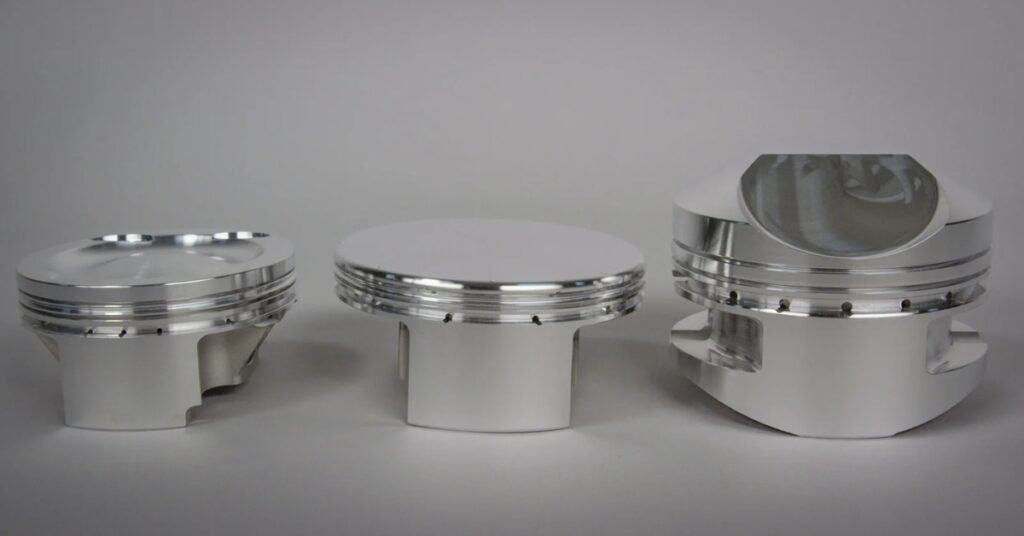
They are flat-surfaced and offer even combustion. They are usually utilized in normal engines.
Dish Pistons
There are curved and inward surfaces to these. They decrease compression and they can be applied in turbocharged engines.
Dome Pistons
These are raised topped so as to enhance compression, which enhances power but need careful design.
Common Piston Problems
Although the piston is designed to be durable in nature, it may still have problems with time:
- Burned Pistons – These are due to overheating or low quality of fuel.
- Cracked Pistons- This is caused by strain or engine defects.
- Worn Piston Rings -Causes oil consumption and white smoke.
- Piston Slap: This is a noise which is brought about by over clearance.
- Damage in Timing Belt Failure -Belt may result in piston and valve collision.
Most of these problems are avoided by frequent maintenance.
Why Pistons are So Important
Engine performance revolves around the piston. Without it, movement will not take place, no power and there will be no vehicle motion.
It endures high pressure, speeds and high temperatures per second the engine operates. Engineers are always enhancing the designs of the pistons to ensure that engines become efficient, powerful, and durable.
The piston can be considered a mere piece of metal, but it is one of the hardest working parts of any engine. What makes vehicles move on a daily basis is its capability of converting the energy in the form of fuel into motion.
The knowledge of the operation of pistons will aid you in appreciating the engineering of the modern engines better. Pistons are very much needed in mechanical systems whether in cars, bikes or machines.
Frequently asked questions (FAQs)
So what is the primary use of a piston?
It transforms the fuel burning energy into mechanical movement.
What is the reason as to why pistons are aluminium?
Due to the fact that aluminium is light, strong and it is also able to cope with heat.
What is the number of the pistons of a car engine?
The most common cars have 4, 6 or even 8 pistons, which vary with the engine.
What is the result of the failure of piston rings?
It causes oil spillage, poor performance and the white smoke.
Can a piston be repaired?
Most of the time the damaged pistons are replaced, as opposed to being repaired.
Disclaimer: This paper is educational and informational in nature. The designs and specifications of its engines can be different each time based on the manufacturer and the model. In case of technical trouble, or professional advice seek the services of an experienced mechanic or car specialist.
Also Read:
16 Types of Measuring Tools and Their Uses in Engineering and Construction
Propeller Shaft vs Drive Shaft: Key Differences, Functions and Uses Explained
Bank 1 vs Bank 2 Explained: Easy Guide to O2 Sensor Locations and Engine Banks