Lever in Physics: Among the simple machines in the world, the lever is one of the most important and commonly used machines. In simple domestic items such as the screwdriver, and in heavy industrial work, such as a pulley, lever assists us in pushing, pulling, cutting and managing objects, with less effort.
They operate through reversal or alteration of a force, which is hard to do, to an easier manner. A lever consists of a rigid bar which turns on a fixed point referred to as the fulcrum.
A lever can either add strength or add control or can change direction of movement by changing the point of force and point of load. Due to this capability, levers have found applications in the daily tools such as scissors, crowbars, bottle openers and even in the human body as some parts.
What is a Lever?
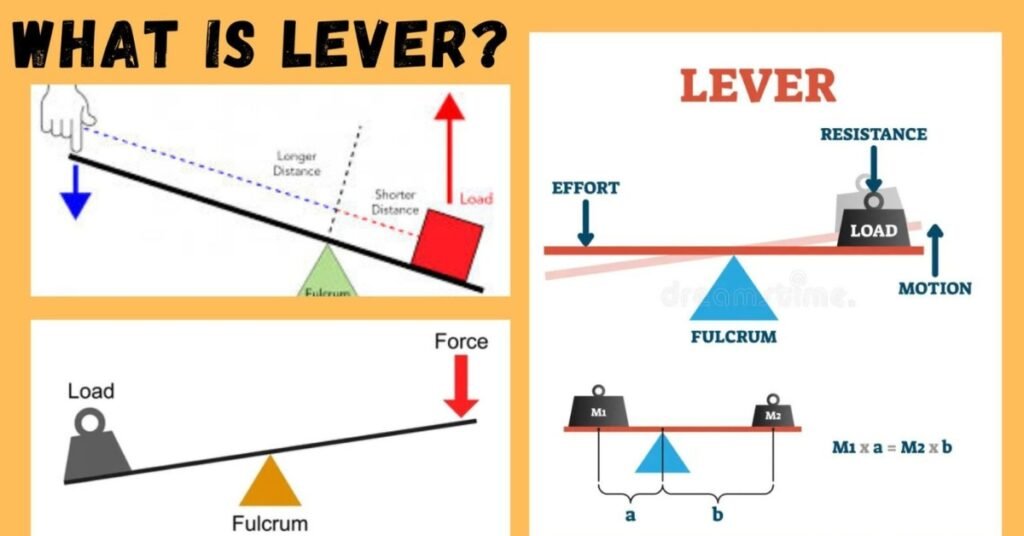
A lever is a simple machine, which is made up of a rod or beam that is rigid and rotates about a fixed point which is called fulcrum. In case a force is applied to one end of the lever, it assists in moving or lifting a load attached at a different position on the beam.
Leverages are meant to produce mechanical advantage. This implies that a small input force can be employed to push a heavy load. The effectiveness of a lever is determined by the locations of three primary components namely the fulcrum, the load, and the effort.
The arrangements of these elements are categorized into three types by the scientists and engineers as far as levers are concerned. All types are applied in various tools and machines and have different purposes.
Parts of a Lever
A lever mechanism operates under a number of simple elements that come into play to create movement and force.
Beam
The beam is the inflexible rod or plank moving around the point of pivot. It is commonly composed of metal, wood or any other hard substance.
Fulcrum
The fulcrum is the point of rotation of the lever. It holds the beam in place and makes it move freely.
Load
The object or resistance to be moved or lifted is referred to as the load. The load is in the unit of Newton (N).
Effort
Effort is the force exerted on the lever in order to move the load. It is quantified in Newtons as well.
Effort Arm
The distance between the effort and the fulcrum is called the effort arm.
Load Arm
The distance between the fullcrum and the load is known as the load arm.
Mechanical Advantage
The term mechanical advantage explains the multiplication of the applied force by a machine.
The formula is:
MA = Effort Arm ÷ Load Arm
In cases where the load arm is shorter than the effort arm, the lever will enable the use of lesser effort to move a greater load.
Principle of Lever
The lever works on the theory of moments. Under this principle, when the clockwise moment is equal to the anticlockwise moment then the lever is in equilibrium.
This can be explained simply as follows: The product of the force on one side of the lever and a distance of that side on the lever multiplied by the product of the distance and the distance on the lever equals the product of the force on the other side of the lever and the distance on that side of the lever.
This concept underlines the explanation of how a small force at a distance is able to move a heavy load which is closer to the fulcrum. That is why such tools as crowbars or long-handled wrenches are so efficient.
Types of Levers
The three categories of levers are based on the location of the fulcrum, load and effort.
First-Class Lever
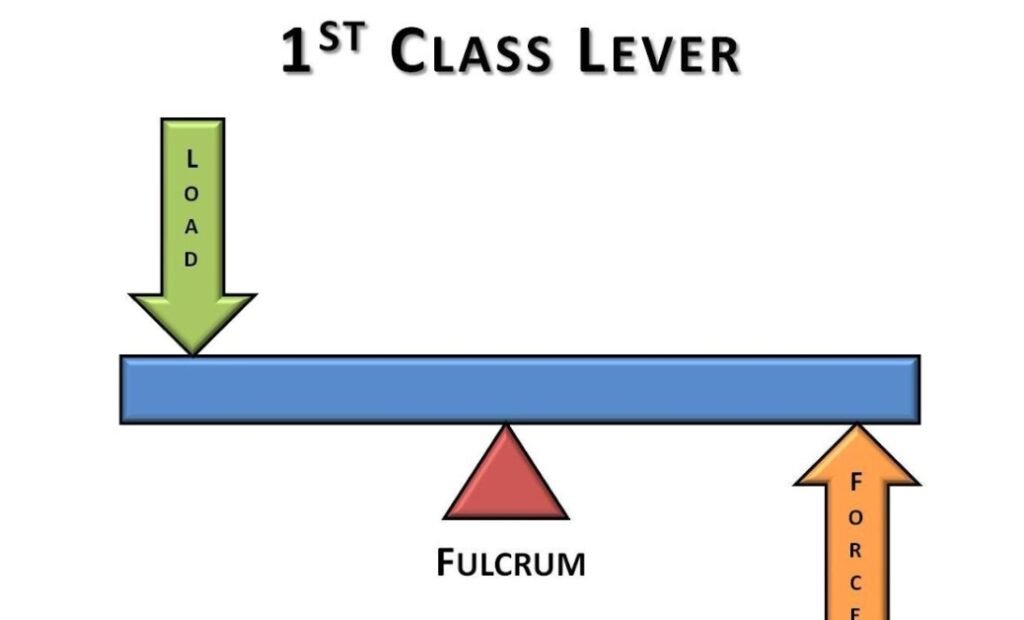
The load and the effort are on either side of the fulcrum of a first-class lever.
This kind of lever has the ability to increase force or alter the direction of applied force according to the location of the fulcrum.
Examples of first-class lever are:
- Scissors
- Crowbar
- Pliers
- Claw hammer
- Seesaw
- Weighing balance
As an illustration, in cases of scissors, the pivot point is the fulcrum, the effort is being exerted at the handles and the load is the material being cut.
Second-Class Lever
In the second-class lever, the load lies between the effort and the fulcrum.
This is a lever that is intended to give more force so that with less effort, one can move a heavy load.
Common examples include:
- Wheelbarrow
- Bottle opener
- Stapler
- Nutcracker
- Nail clippers
The wheel of the wheelbarrow is the fulcrum, the tray is the load and the handles provide the effort.
Third-Class Lever
In third-class lever, the load is arranged between the load and the fulcrum.
This kind of lever boosts pace and range as opposed to force.
Examples of third-class levers are:
- Fishing rod
- Broom
- Baseball bat
- Human jaw
- Bow and arrow
A tremendous example is the human arm. The fulcrum is the elbow, the muscles exert our efforts in the middle, and the load is lifted off by the hand.
Uses of Levers in Daily Life
Leverage is in all things. Numerous instruments and machines are based on the principles of lever to operate successfully.
Some common uses include:
Moving heavy items using equipment such as crowbars or wheel barrows.
- This involves the use of scissors or pliers in order to cut materials.
- Leveraging nails out of wood with a hammer claw.
- Using bottle openers to open the bottles.
- Assisting athletes in moving some equipment like the baseball bats or golf clubs.
Leverages enable individuals to do things that would have been much more difficult without leverage.
Frequently Asked Questions (FAQs).
- What is a lever in physics?
A lever is a simple machine that is composed of a stiffed bar that rotates about a fixed point referred to as fulcrum to either move or lift loads.
- What do we know about the three types of levers?
It is divided into three namely first-class lever, second-class lever and third-class lever.
- What is the fulcrum in a lever?
The point around which the lever rotates is that of fulcrum.
- What is the mechanical advantage of a lever?
The ratio of the effort arm to the load arm which indicates the degree to which a lever increases the applied force is referred to as mechanical advantage.
- What are the typical examples of levers in real life?
They can be scissors, crowbars, wheelbarrows, bottle openers, fishing rods or the human arm.
Disclaimer: The article is not meant to be a commercial one. The accounts given on levers and simple machines are related on the general physics conceptions. The actual use can differ according to design, engineering requirements as well as actual conditions on the ground.
Also Read:
50 Important Car Parts Names and Functions Explained for Beginners
21 Types of Trucks and Their Uses: Complete Guide to Different Trucks
Propeller Shaft vs Drive Shaft: Differences, Functions and Types Explained